Sunday School
Craps Odds and Payouts Chart (Printable)
·
Too long, didn't roll. Pass line 1.41 percent. Don't pass, 12 barred, 1.36 percent. Place 6 or 8 is 1.52 percent. A field that doubles 2 and 12 is 5.56 percent. If one of those pays triple, it is 2.78 percent. Any seven is 16.67 percent. Odds bets pay true odds and have no house edge of their own.
How to read this chart
Every bet on a craps layout has a true price and a house price. True odds are what a fair game would pay. The house pays less, or it pays the same and wins more often than it loses. The difference is the house edge. It is a percent of the money you put at risk, not a prediction of your next roll.
The figures below are for the common US layout: pass line, don't pass with 12 barred, field on 2, 3, 4, 9, 10, 11 and 12, and the usual proposition prices. A felt can print a different field or a different bar. If the cloth and this chart disagree, believe the cloth you are playing on, then do the math again. Our layout guide shows where those words sit.
Print the chart, or download it, and put it on the rail. Arguing about a payout in the middle of a roll is how home games end early. The numbers are not a system. They are a price list.
Payout chart
| Bet | Pays | House edge | Note |
|---|---|---|---|
| Pass line | 1 to 1 | 1.41% | Come-out: 7 or 11 wins, 2, 3, or 12 loses. Any other number is the point. |
| Don't pass (12 barred) | 1 to 1 | 1.36% | Come-out: 7 or 11 loses, 2 or 3 wins, 12 pushes. Mirror of the pass line after the point. |
| Come | 1 to 1 | 1.41% | Same math as the pass line, starting on the next roll. |
| Don't come | 1 to 1 | 1.36% | Same math as don't pass, including the bar on 12. |
| Odds 4 or 10 | 2 to 1 | 0% | True odds. No house edge on the odds portion itself. |
| Odds 5 or 9 | 3 to 2 | 0% | True odds. |
| Odds 6 or 8 | 6 to 5 | 0% | True odds. |
| Place 6 or 8 | 7 to 6 | 1.52% | True odds would be 6 to 5. This is the best place bet. |
| Place 5 or 9 | 7 to 5 | 4% | True odds would be 3 to 2. |
| Place 4 or 10 | 9 to 5 | 6.67% | True odds would be 2 to 1. Buy bets can be closer after commission. |
| Field, 2 and 12 pay double | 1 to 1, 2 to 1 on 2 and 12 | 5.56% | One roll. 5, 6, 7 and 8 lose. |
| Field, 2 or 12 pays triple | 1 to 1, one of 2 or 12 at 3 to 1 | 2.78% | Read the felt. Only one of the two usually pays triple. |
| Hard 6 or hard 8 | 9 to 1 | 9.09% | Wins only on the pair. Easy six or eight, or a seven, loses. |
| Hard 4 or hard 10 | 7 to 1 | 11.11% | One way to win, eight ways to lose before it hits. |
| Any seven | 4 to 1 | 16.67% | One roll. True odds are 5 to 1. The worst common bet on the layout. |
| Any craps | 7 to 1 | 11.11% | 2, 3 or 12 on the next roll. True odds are 8 to 1. |
| Yo (11) or ace-deuce (3) | 15 to 1 | 11.11% | True odds are 17 to 1. |
| Aces (2) or twelve | 30 to 1 | 13.89% | True odds are 35 to 1. |
| Big 6 or Big 8 | 1 to 1 | 9.09% | Many tables dropped these. Place the 6 or 8 instead. |
Download the PDF · Download the PNG
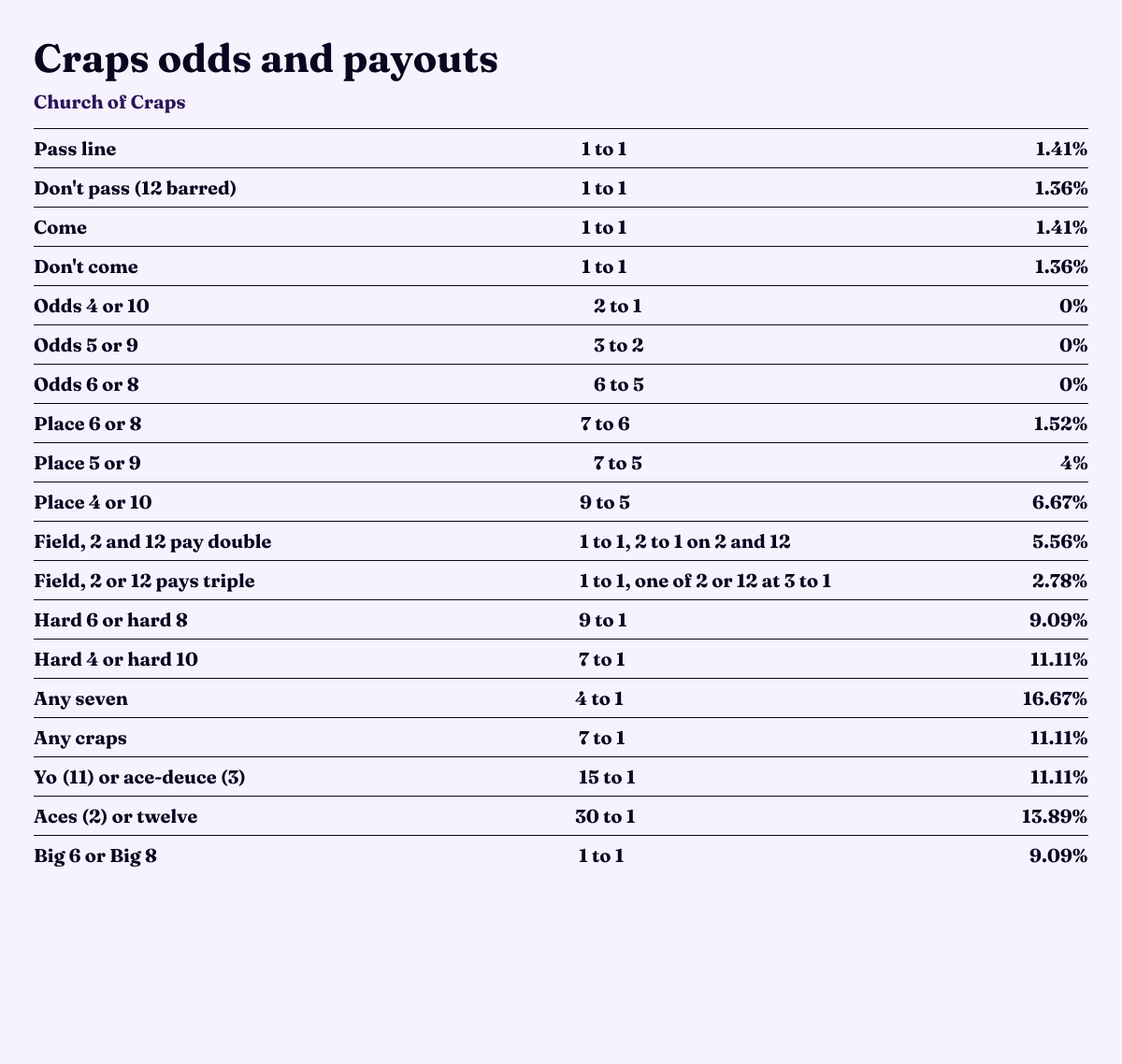
Edges are rounded the way players usually say them. Pass line is 1.41 percent, which is 7/495, about 1.414 percent. Don't pass with the 12 barred is 1.36 percent. Place 6 and 8 are 1.52 percent, which is 1/66. Any seven is exactly 1/6 of the bet, 16.67 percent, because you are paid 4 to 1 on a 5 to 1 shot.
A zero in the edge column means the odds portion only. It does not make the pass line under it free. The pass line is still 1.41 percent. Adding odds lowers the edge on the combined stack because a larger share of the stack is fair. It does not turn the game into a job.
Why the pass line is 1.41 percent
On the come-out there are 36 ways two dice can land. Six of them are 7. Two of them are 11. That is eight wins. One way is 2, two ways are 3, one way is 12. That is four losses. The other 24 rolls set a point. The point then has to return before a 7, and the chance of that depends on the point. Four and 10 are the hardest, with three ways to hit and six ways to seven out. Six and 8 are the easiest of the points, with five ways to hit and six ways to seven.
Weight those paths and the pass line wins slightly less value than it loses. The missing piece is 1.41 percent of the money bet. You can have a winning night. You can have ten winning nights. The edge is what remains when the nights are added up. Anyone who quotes a lower number for a bare pass line, with no odds, is using a different game or a different wish.
Don't pass flips the wins and losses and then bars the 12, which would otherwise be a don't win on the come-out. Barring it, a push, is how the house keeps 1.36 percent instead of handing the player the pass line's edge. Some tables bar the 2. Do not bar both. Barring both is a different, worse bet, and a home layout should not invent it.
Place bets and the field
A place bet on 6 wins if a 6 shows before a 7. There are five ways to roll a 6 and six ways to roll a 7, so the true price is 6 to 5. The layout pays 7 to 6. On a six dollar bet you should have been paid seven dollars and twenty cents at true odds. You are paid seven dollars. The missing twenty cents, averaged over the ways the bet resolves, is the 1.52 percent edge. It is the best of the place bets. It is still not better than pass line with odds.
Place 5 or 9 should pay 3 to 2. The house pays 7 to 5. The edge is 4 percent. Place 4 or 10 should pay 2 to 1. The house pays 9 to 5. The edge is 6.67 percent. Buying the 4 or 10 pays 2 to 1 and charges a commission, often 5 percent. Do the commission on a calculator before you decide it is a bargain. On a twenty dollar buy, a dollar commission up front is not nothing.
The field loses on 20 of the 36 dice faces: the 5, 6, 7 and 8. It wins on the other 16. Most of those wins pay even money. The 2 and the 12 are one face each. If both pay double, you are short two units per 36 faces, which is 5.56 percent. If the felt pays triple on the 12 or on the 2, you claw back one of those units and the edge falls to 2.78 percent. A field that pays triple on both is rare. Do not assume you found one because the color is nice.
Proposition bets, including any seven
Any seven is a one-roll bet that the next roll totals 7. Six faces out of 36 do that, so the true price is 5 to 1. The layout pays 4 to 1. You risk one to win four, on a bet that should pay five. The gap is one unit on a six-face cycle, which is 16.67 percent. There is no soft version of this number. It is the reason serious players leave the center of the table alone.
Any craps, a one-roll 2, 3 or 12, has four faces and true odds of 8 to 1. It usually pays 7 to 1. The edge is 11.11 percent. Yo and ace-deuce have two faces each, true odds 17 to 1, and usually pay 15 to 1. Same 11.11 percent edge. Aces or twelve, one face, true odds 35 to 1, usually pay 30 to 1. The edge is 13.89 percent.
Hard 6 and hard 8 win only on the pair. The easy ways and the 7 all lose. There is one way to win and ten ways to lose, so you should be paid 10 to 1. The layout pays 9 to 1. The edge is 9.09 percent. Hard 4 and hard 10 have one way to win and eight ways to lose. True odds are 8 to 1. The layout pays 7 to 1. The edge is 11.11 percent. They are slower than any seven, which makes them feel safer. The price does not agree.
How to use the chart at the table
Before the session, circle two bets you will make and one you will not. A clean pair is pass line plus odds, or don't pass plus odds. Place 6 and 8 can join them if you like more action and accept 1.52 percent. The field can be a one-roll amusement if you know which price your felt charges. Any seven should stay in the 'will not' circle.
When someone offers a bet the chart does not list, stop and price it. Hop bets and novelty bonuses are usually a proposition in a new jacket. If the payout is worse than true odds, the edge is the gap. If nobody can say the payout, do not put a chip down.
Keep the printable copy with the dice. A phone chart works until the battery dies and someone is sure the field pays triple. Paper does not need a signal. The game is more fun when the argument is about the dice, not about the ink.